
Fishing for Context

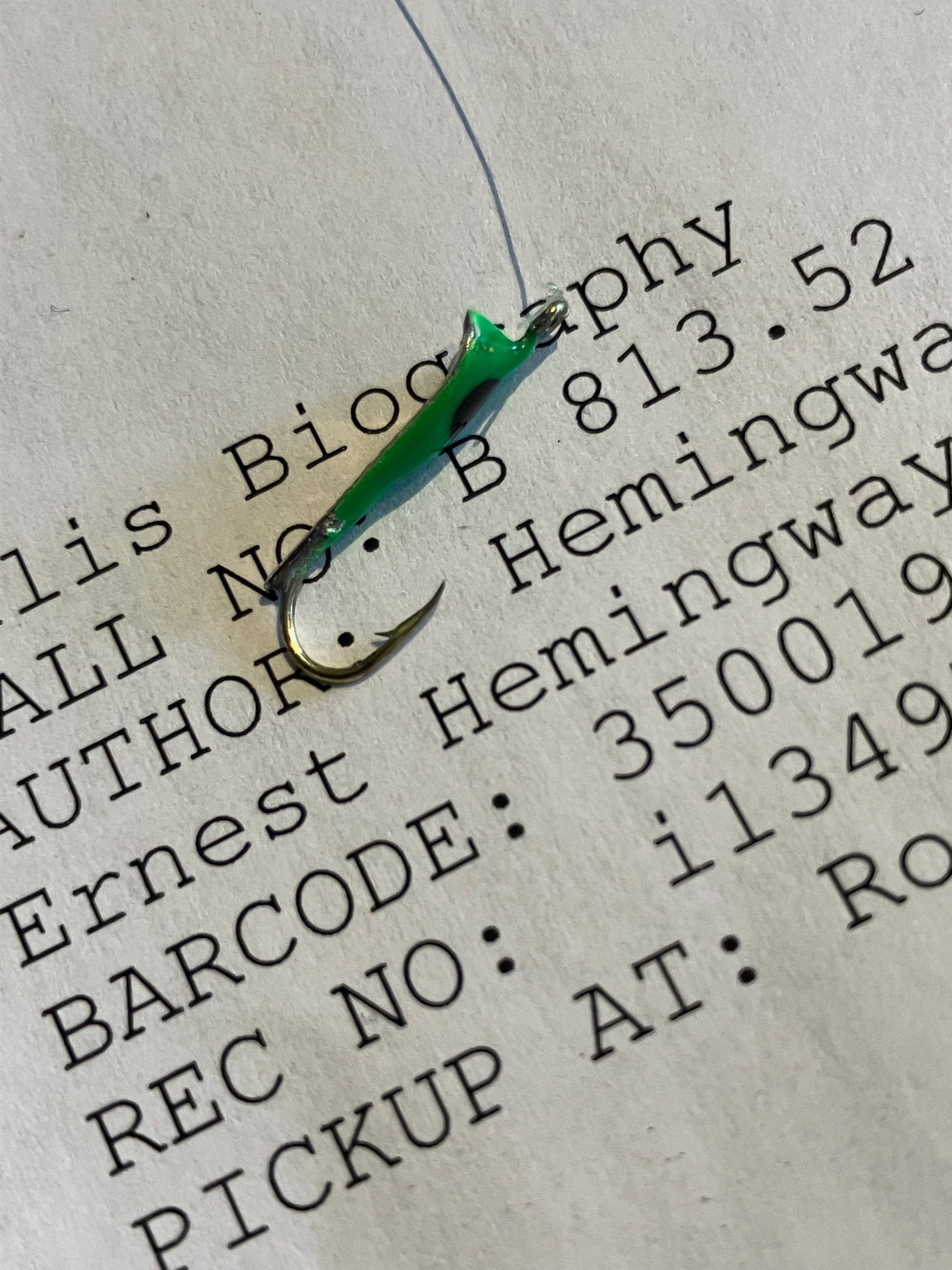
Some weeks ago I scrolled upon a meme here on Substack that featured a quote from Ernest Hemingway about his novel, The Old Man and the Sea:
“The sea is the sea. The old man is an old man. The boy is a boy and the fish is a fish. The shark are all shark no better no worse. All the symbolism that people say is shit.”
Gosh, reading this I was so glad this matter has finally been laid to rest. I mean, this is the author, right? That makes him an authority on his own writing, right?
Honestly, no: I do not think so. This being social media, of course I had to venture an opinion, and after giving it some thought I wrote a comment that went something like: “Writers have about as much of an idea what they’re doing when they write as parents do when they’re having children.”
The implication being: Like children, our writings come from places we don’t fully understand and then move into minds and worlds and futures we know nothing about, nor ever will. As they move into new contexts, they gather new meanings.
I posted my comment and I felt good about that contribution — for a few minutes.
Then the quote was abruptly re-contextualized. I looked online and found a longer version. Whoever created the meme I first saw had decided to leave out the line that follows. The longer quote reads:
“The sea is the sea. The old man is an old man. The boy is a boy and the fish is a fish. The shark are all shark no better no worse. All the symbolism that people say is shit. What goes beyond is what you see beyond when you know.”
Reading that, I thought: Whoa! That’s an interesting turn. What does that even mean? It’s taken weeks to come up with a provisional answer. As I continued thinking about it, I also wondered what all the online fuss about that meme really boils down to — our comments, reactions, repostings and so on — now that I know there’s more to the original quote. And what else got left out?
Fortunately, the webpage where I found the longer quote also provided the reference I needed to start answering this last question, a book titled Ernest Hemingway, Selected Letters, 1917-1961.
It took a couple weeks for the book to become available via loan from a library two counties over. The reason I mention this is because waiting for the physical book and driving to our local library to pick it up marks a pretty radical departure from the “scroll, click, like, comment” pattern that social media platforms tend to encourage. Instead of staying in the flat online universe where momentary stimulation is typically followed in short order by amnesia, I “went vertical.” I started digging, I started diving. In fact I started moving omni-directionally. I let the whole experience really sink in instead of rushing off to the next clickable item.
Part of this involved waiting for the book’s arrival. The value of waiting is another thing online culture tends to discount. Eventually I moved my attention from a mere meme on a screen to a physical book that had to be located and trucked and fetched from the library to get my physical hands on it, yet one more thing the internet tends to discourage. Why walk across the room and pick up a dictionary when we can stay where we are and so quickly and efficiently look up a definition online? Here’s one answer: because the physical act of turning the pages might help us remember and learn. Here’s another one: because engaging our wills and actually standing up for something can become a habit.
And for those who read my previous post, About That Garbage Truck Parked on the Altar, that very library visit to pick up the book unexpectedly led to experiences and conversations that illuminated that essay in a whole new way. The un-programmed world remains larger than the programmed one, and always will. That said, I’ve done plenty of online scrolling and clicking over the years. I’m reporting here on what happened when I peeled a tiny online experience off the screen and started acting on it. Guess what? It got bigger.
When I got home with the book I found the quote in the letter Hemingway had written to art historian Bernard Berenson, dated September 13 1952. Turned out there was yet another relevant line that followed those already shared:
“The sea is the sea. The old man is an old man. The boy is a boy and the fish is a fish. The shark are all shark no better no worse. All the symbolism that people say is shit. What goes beyond is what you see beyond when you know. A writer should know too much.”
Each added sentence re-contextualizes and expands the scope of what’s being said. But perhaps for that very reason, the shortened quote that ends so satisfyingly with a four-letter word probably makes for a better meme. It’s easier to imagine that we understand it.
So I guess the question is: Do we prefer clarity achieved at the expense of missing context, possibly even punctuated with vulgar language? Or do we gravitate toward the richer, more ambiguous readings that can come from including these other lines, plus those that precede and follow them, and maybe much else besides?
For example, I was surprised, soon after Hemingway’s brash and frequently quoted “tough-guy” lines about The Old Man and the Sea to find a fawning, extremely hat-in-hand request in this letter to Berenson to please write a few lines about the book for the publisher. I laughed out loud. It was quite a contrast.
Point is, there’s always more to the story. We can keep expanding interpretive contexts in all kinds of directions. By doing so, new kinds of clarity as well as rich veins of ambiguity will emerge. Or we can just do the easy thing, the engineered-choices thing, the monitored-and-tracked thing that has been so effectively marketed as progress: Scroll and react.
Speaking of context, one way of contextualizing this essay is that it’s kind of a geeky piece of writing by a former high school English teacher about a quote by Ernest Hemingway. That’s an interpretive framework right there. But while Hemingway can say “the sea is the sea” and so on, let me be equally clear in saying in this essay at least, that quote is way more than just a quote. It’s an example of how anything can have its context curated to create a particular reading, and how dramatically this can change how we see things and what they mean. Relevant details can either be left out or included. Heck, in the larger world, events can even be staged and reporting on events can be crafted as needed to provide contextual support for desired narratives.
Meanwhile the news scrolls by. There’s a saying, “Oh, that’s yesterday’s news,” by which people imply that something is no longer relevant or worth thinking about. In reality, yesterday’s news — and last week’s and last year’s — are important parts of the interpretive context of today’s news. If we forget, we lose that context, and with it a bigger picture that might help us make sense of things.
The world of the meme, like the sound byte and the “news reporting” Neil Postman warned us about forty years ago, inclines toward a state that is dimensionless, self-contained, and self-referential. One risk of these platforms is that with every click on our machines, we become a little more robotic and mechanical ourselves. Some social media platforms explicitly encourage us to “react.” Since when is reactivity a good thing? Who benefits from people becoming more reactive? Not us.
But the bigger takeaway here goes far beyond even that sobering thought. Here’s the current best read I have on this whole experience: There is no limit to how far we can expand our interpretive frameworks, no end to the new contextual dimensions available to us. This writing is merely a demonstration of how that can work.
Still, I agree with Hemingway if he’s saying that reading about fishing is not the same as actual fishing. I agree that an easy retreat into talk about symbolism can amount to a cowardly withdrawal from the gritty realities he so often depicted in his writing. Actual fishing, in fact, can change our reading. Indeed, sometimes reading can feel a lot like fishing: What’s down there, really? Can we stay alert and responsive to the tug of a given line and to what might be happening in the depths where it touches us? Do we have the patience, courage and willingness to find out?
Am I supposed to write this comment or just think about what you wrote?
Ooooooh. Ha.
Perhaps you might write ten follow-ups to this post, Cliff? It is truly profound, and a great deal more could be said.
What was the world like before we had Substack? Before we had the Web? Before we had computers? It wasn't better, for sure. I do remember the utter boredom and lack of information -- frustrating ignorance -- in my youth. Now we seem to be in a place of terrible overload, which is why your driving to the library is kind of a sane throwback to another time.
If everyone could fly fish in a knowledgeable way for just one hour on the AuSable, it would instantly be a better world.
As a writer, I have to say I object to that fellow choosing a last word that was not the last word.
I am pretty sure he is not a fly fisherman.
This resonates almost completely with what I’ve been giving attention to lately. The dictionary / public meaning of words is not exactly what’s meant when they are used. Words gather meanings as they are used by us. What we want a word to mean when we use it has everything to do with context. And often we argue with people because we don’t understand what they want the words they are using to actually mean. When i learned to ask “what do you want …. to mean?” I found how often others used a word differently from how I would use it.
“What goes beyond is what you see beyond when you know.”
I hear Hemingway saying that we have to go beyond what we know to know “the more” about something. As you say, there’s always more.
We think more than we can say.
We feel more than we can think.
We live more than we can feel
And there is so much more.
Eugene Gendlin