
You're a Gem!

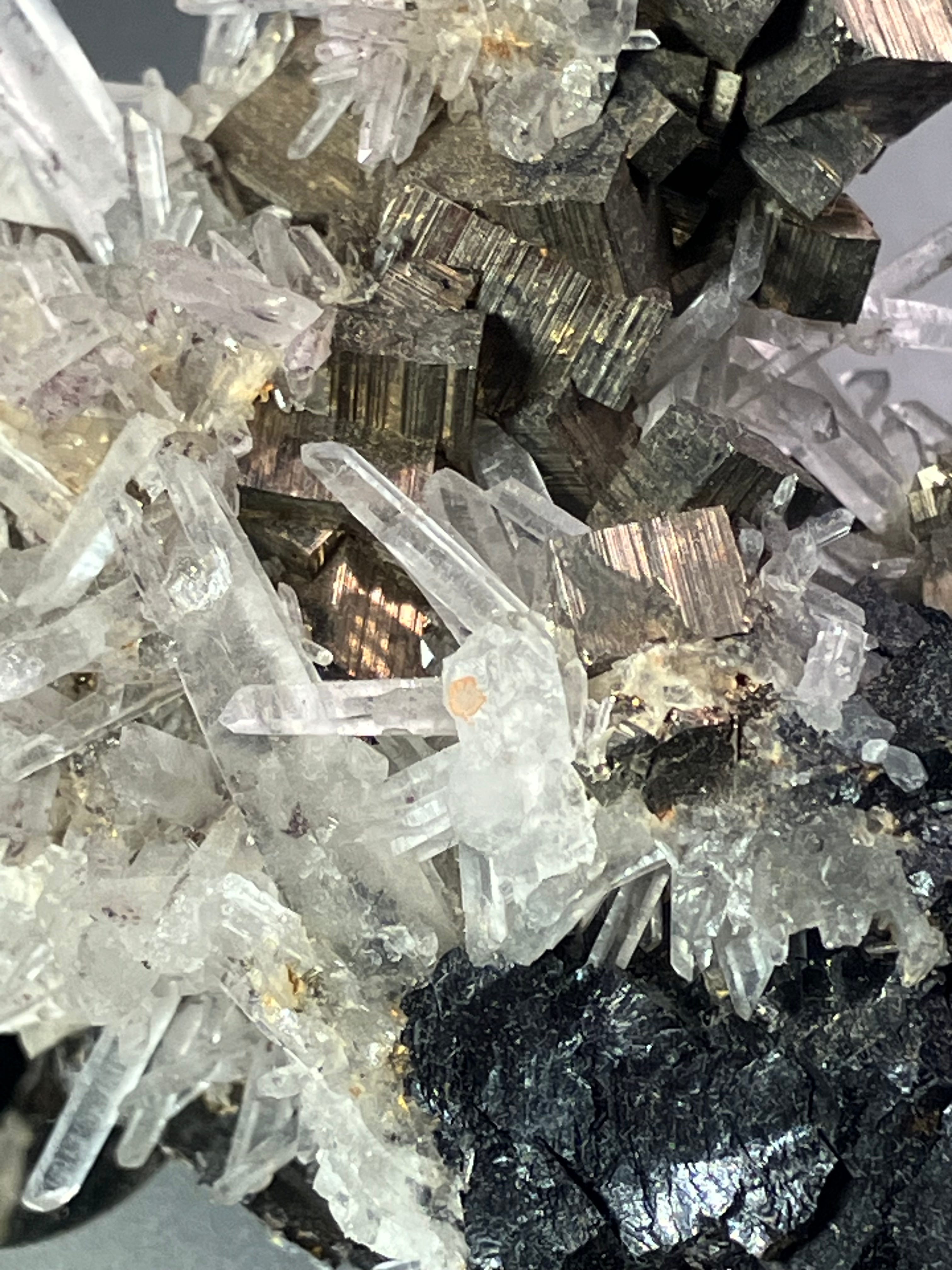
I’ve recently started looking into what are called “single-source gems.” As the name implies, these are stones and mineral species found in only one location on the planet.
My favorite example right now is tanzanite, and not just because I adore its vibrant blue-to-purple color but also because I find the story of its discovery kind of interesting. It is said to have been first found in 1967 by Masai tribesman Jumanne Ngoma, who spotted the intensely blue-violet stone in the foothills of Mount Kilimanjaro. Linked here is an online article with photos of the mineral and here’s another one with quotes from the local press. From what I’ve read, Tiffany & Co. got hold of the stone soon after its discovery and had a hand in naming it after the country in which it was found, Tanzania.
The mineral has an unusual optical quality called trichroism, meaning the same crystal shows three different colors when viewed from each of three different viewing angles. All the tanzanite in the world comes from an area only about 2km by 7km in extent.
There are many strange parts of this story — an industry that wholesales an estimated $50 million annually built on a mineral find whose discoverer was initially dismissed and only belatedly rewarded. But the biggest reason this is worth sharing about is that tanzanite is a reminder that this planet holds mysteries and beauties that are just waiting to be discovered. In fact, the trichroic optics of tanzanite could be seen as a clue to finding those other beauties. It’s like the planet trying to tell us: “Look at this from another angle. You’ll see something new, surprising and different!”
We can all do this. We have that power.
I’ll link a couple videos here and here so you can observe how this rare optical effect works in tanzanite, how the color distinctly shifts from blue to purple to burgundy and other hues.
Now, if you start poking around on the web you’ll see a lot of information out there on tanzanite and its rarity, price, and grades. I just saw a video online last night with these words in the thumbnail image: Tanzanite as an Investment. You can also read about the original marketing campaign by Tiffany and about the miner who became an overnight millionaire in 2020 with the unearthing of two particularly large pieces of tanzanite.
Funny how in mainstream culture whenever commerce gets ahold of something it becomes more “real” to people. Start assigning dollar values and all of a sudden, “Oh, that’s serious business!” We tend to forget: that’s just one viewing angle. But wow, does the “money angle” color a lot of people’s worlds.
Me being a poet and all, of course, finding the different viewing angles is central to what I do. This entire channel is devoted to finding and sharing those viewing angles. What I find is that just by adjusting my vision, ordinary moments can become luminous and revealing. And I never know what’s going to come to the surface.
Here’s one such angle: Uniqueness is universal. Everything is unique. And it may seem paradoxical, but the fact that uniqueness is universal does not in any way diminish the fact of its uniqueness. A sunrise, a cloud pattern in the sky. All fresh and new emerging from the planet, often with astonishing color changes of their own. A dragonfly that lands nearby. It’s impossible to predict or replicate that moment. But the very fact that such uniqueness is universal tends to hide it from view.
We call a day Monday or Tuesday. As if it’s the same as other Mondays or Tuesdays because of the name it was assigned. Nope. They’re unique. We also tend to forget, for example, that people are, in essence, single-source gems, emerging onto the surface of the planet from unseen depths, each of us shining with our own colors and reflecting and bending light in our own ways.
Now, there’s a risk in inserting such ideas into an essay like this. Sounds abstract… too much work… what’s he even talking about? Easier to just gloss over them. But I’m leaving this in because there’s a place we can stand within ourselves where all of this becomes self-evident, and from that angle, things look different.
Now let’s take a look at some other single-source stones, all which have their own specialness. Given the limits of language in describing things, I’ll provide some links to online images for those who are interested.
There’s charoite, for example, discovered in the USSR in the 1940s, whose lavender, violet or purple hues mix in swirling patterns with other minerals in various proportions. It can also have the property of chatoyance, which refers to a mobile inner sheen shared with minerals like tigereye as it gathers light in its depths and reflects it back out.
Then there’s larimar, found only in the Dominican Republic. It’s a beautiful greenish- blue stone and I’ve read some people in the Dominican Republic wear it as a sign of national pride. According to the website Dominican-Larimar.com, it was named in 1976 by one of the second known discoverers of the stone, Miguel Mendéz, who combined his daughter’s nickname, Lari, with the Spanish word for sea, mar to form the word larimar. In photos it has a gorgeous depth of sea-green coloration.
The United States also has single-source gems that make the list, like benitoite, a dichroic, single-source mineral in violet and blue said to have been discovered in 1907 in California’s Diablo Range and named after San Benito County. Then again, imagine a red emerald. That would be bixbite or red beryl, reportedly discovered in 1958 in the Wah Wah Mountains of West-Central Utah, and much, much rarer than diamonds.
Personally, in my work as a book coach and editor, I encounter a lot of single-source gems in my clients’ writing — those shining moments in a narrative that sometimes surprise even the authors with their own brilliance. I see and feel the shifts in the color of the language with different perspectives. And I notice that the ways the different authors transmit light are all unique because the authors are all unique. I love the mobile inner sheen where one part of a narrative sheds light on another, and the depths that become visible as a result. And I also see a lot of honest sweat and digging going on to bring these beautiful things up and into the light.
Naturally, the list of rare and beautiful things goes on, every unique, single-source moment by unique, single-source moment.
And every one of us belongs on that list, too. Every one of us an exquisite single-source gem.
Time to show our colors and shine.
This brought a unique smile to my face on this unique Wednesday morning 😊🙏🏼
As Ronnie James Dio said,"A rainbow in the dark". See how we shine.